











Researchers identify the distinctive marks that plant roots leave on bones
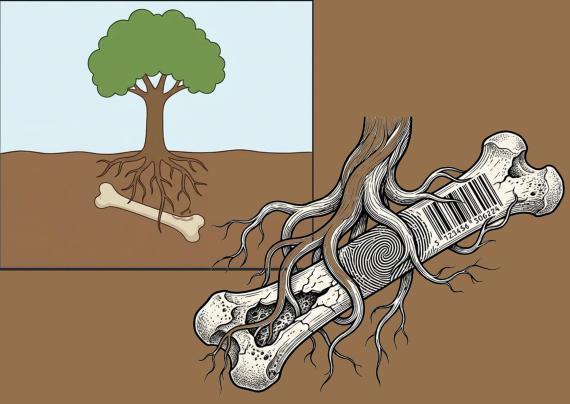
2026 A team of researchers from the National Museum of Natural Sciences (MNCN-CSIC) led an international research project that was published today in Plos One. The project is one of the first controlled experiments to analyze the distinctive marks that plant roots leave on bone remains under natural conditions. This study opens up new avenues for reconstructing past for new methods of reconstructing past environments and conducting forensic investigations. The study is a long-term project to create a database of patterns produced by different types of plant roots on bones. The results have various applications, including interpreting the habitat of a fossil site more accurately, improving time estimates since death, identifying potential body transport from an original burial site, and determining past climate changes.
The research has significant implications for fields such as paleoecology, archaeology, and forensic science
Plants absorb minerals from bones, such as phosphates. Their roots release acids to corrode the bones and leave specific marks. The team analyzed this effect of the roots in a semi-arid Mediterranean environment after burying various bones at depths of 25 and 50 cm for periods of one, three, and 10 years. Specifically, they characterized different types of representative vegetation—holm oak (Quercus ilex), olive trees (Olea europaea), and grapevines (Vitis vinifera)—and compared them with root marks from previously analyzed aquatic, subterranean, and aerial plants. “Analysis using optical and electron microscopy has allowed us to identify distinct patterns depending on the type of vegetation: holm oaks, which have deep roots, created sinuous, branched grooves with irregular edges; olive trees, whose root systems extend more shallowly through the soil, produced straight, superficial marks; and grapevines, with their strong roots that cling to the soil, left linear engravings with cracks and circular marks with a reddish discoloration on the bone,” described MNCN researcher Alba Macho-Callejo.
A Key Tool for Taphonomy
“Since each type of plant leaves a characteristic signature on the bone, we can determine what type of vegetation was present at the time of burial. This information can enhance our understanding of paleontological sites”, mentions Dores Marin-Monfort, a researcher at the National Scientific and Technical Research Council of Argentina (CONICET), who is participating in the research. “In fact, the marks reflect the predominant environment, making them very valuable environmental indicators that allow us to determine how the environment changed based on the patterns we detect in each layer of a site,” notes Yolanda Fernández-Jalvo.
Researchers analyzed the effect of the roots of holm oaks, grapevines, and olive trees on bones buried for between 1, 3, and 10 years at different depths
This research marks a significant milestone for taphonomy, the discipline that studies the processes affecting organic remains after death. "Until now, root marks were known, but there were no controlled experimental studies that allowed us to discern which type of plant each pattern corresponded to,” says Sara García-Morato, co-author of the study. “The marks are imprinted on the bones and remain intact when they fossilize. Thus, this study fills an important gap, as we can now differentiate between marks caused by different types of plants and those produced by animals, tools, or physical processes,” notes Macho-Callejo.
This study began in 2012 when various bones were buried in contact with roots from different types of plants at the Higueruela Experimental Station (Santa Olalla, Toledo). It is a taphonomy project led by Yolanda Fernández-Jalvo, with support from Dores Marín-Monfort, who replicated the experiment using greenhouse plants.
Implications for Forensic Analysis
In addition to demonstrating that the intensity of these marks increases with burial depth and exposure time, the study shows that these alterations can appear in as little as one year, which is particularly relevant in forensic contexts. According to Aida Gutiérrez, a forensic anthropologist also at the MNCN: “The rapid appearance of these marks indicates that they can be used even in recent investigations to determine whether a body has been moved after burial and to refine the estimate of the time elapsed since death—not only in archaeological or paleontological contexts.”
A Library of Marks
This work is part of a much more ambitious project involving new experiments designed to expand the database of marks by including more plant species and longer burial times. “For now, in addition to grapevines, olive trees, and holm oaks, we already know the distinctive marks left by certain herbaceous plants, and we will continue to expand the record of patterns,” notes Fernández-Jalvo. “The goal is to build a ‘library of traces’ that will allow us to more accurately identify the vegetation associated with skeletal remains in any context,” she concludes.
Date
Friday, 19 June 2026Publicado en
PlosONEInvestigador
Yolanda Fernández Jalvo Sara García Morato Alba Macho-CallejoReferencias
A. Macho-Callejo, D. Marin-Monfort, A. Gutiérrez, S. García-Morato y Y. Fernández-Jalvo. (2026) First steps towards distinguishing Mediterranean vegetation root marks on bones: An experimental approach. PlosOne. DOI: https://doi.org/10.1371/journal.pone.0351568
