







Seminarios de investigación
Accede a los seminarios de investigación celebrados en el Museo Nacional de Ciencias Naturales.
Seminarios de investigación en el canal Youtube del MNCN
Próximos
MAYO
FOUR DECADES AS AN ANTARCTIC ECOLOGIST, HOW HAS ANTARCTIC TERRESTRIAL ECOLOGY CHANGED?
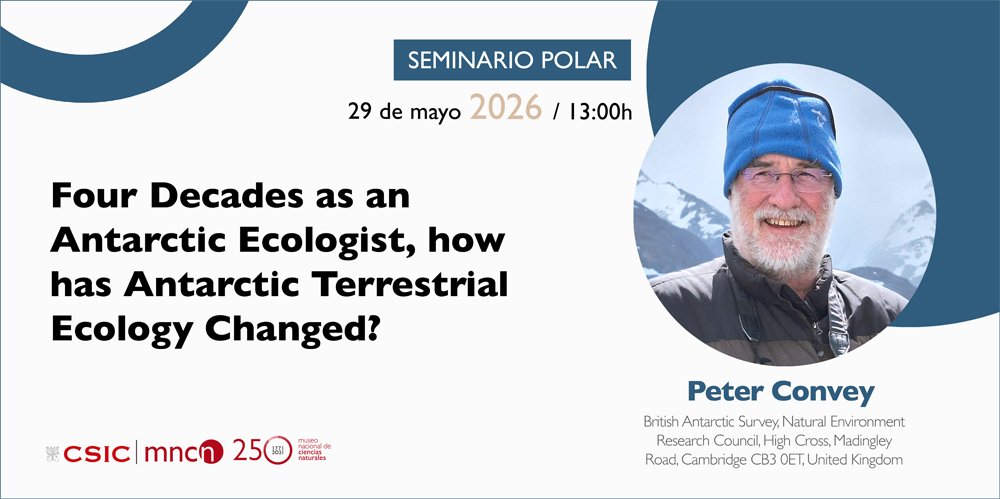
Ponente: Peter Convey, British Antarctic Survey, Natural Environment Research Council, High Cross, Madingley Road, Cambridge CB3 0ET, United Kingdom
Fecha y hora: viernes 29 de mayo de 13:00 a 14:00
Lugar: salón de actos del MNCN
Abstract: Terrestrial and freshwater life in Antarctica is surprisingly poorly known, even now. Today it is dominated by lower plants and lichens, microarthropods and other microinvertebrates, and microbial groups, although that has not always been the case. Most currently ice-free ground in Antarctica and on at least some of the surrounding sub-Antarctic islands would have been covered and scoured by glacial advances at the Last Glacial Maximum and previous maxima. However, as new baseline survey data has become available, combined with modern molecular biological analysis, it has become clear that isolation, long-term persistence, and regionalisation are general features of the Antarctic terrestrial and freshwater biota. As well as creating a new paradigm in which to consider the evolution and adaptation of Antarctic terrestrial and freshwater biota, important new cross-disciplinary linkages have opened in the fields of understanding the geological and glaciological history of the continent itself and its neighbouring landmasses, and of the climatic and oceanographic process that can both lead to isolation and support colonisation processes. This new and more complex understanding of Antarctic biogeography now provides important practical challenges for management and conservation in the region as is required under the Antarctic Treaty System, in the face of growing human activity and impacts, and of considerable regional climate change.
JUNIO
THE ATLAS OF HUMAN IMAGINATION. "HOW THE HISTORY OF IDEAS CAN BECOME THE FUTURE OF IDEAS"
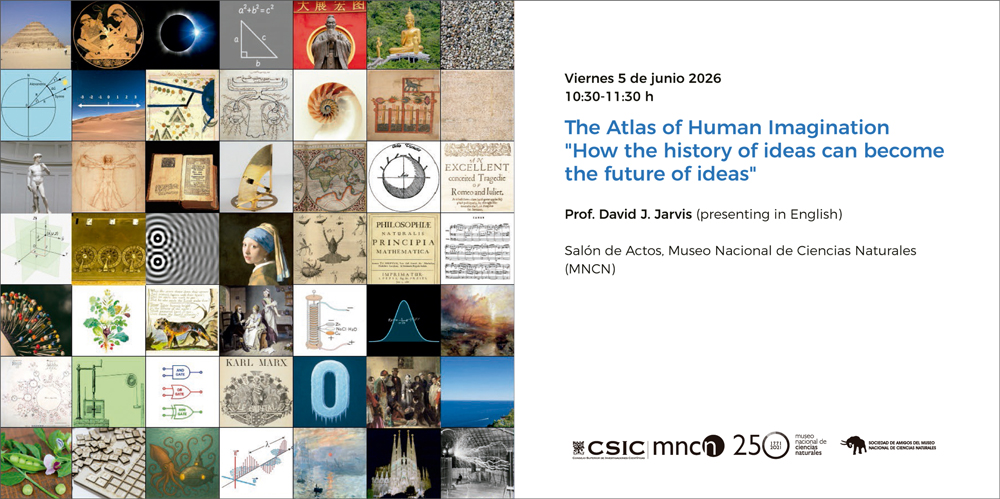
Ponente: David J. Jarvis, International Fellow of the Royal Swedish Academy of Engineering (IVA) in Stockholm and an Elected Fellow of the Institute of Materials, Minerals and Mining (IOM3) in London
Fecha y hora: viernes 05 de junio de 11:00 a 12:00
Lugar: salón de actos del MNCN
Abstract: The Atlas of Human Imagination presents a core philosophy: that art, science and the humanities are not separate silos, but a unified narrative of human ingenuity. By mapping these convergences and interconnections, the Atlas shows how a shift in philosophy or an artistic movement often paves the way for scientific revolution, and vice versa. This cross-disciplinary mapping of 4,000 years of human imagination provides a unique lens through which to view the world around us. Timed with World Environment Day on Friday 5th June, this talk will explore how the "history of ideas" can serve as a blueprint for the "future of ideas," specifically regarding our relationship with the natural world and climate action.
JULIO
HOW TO BUILD A HARE: MORPHOLOGICAL EVOLUTION OF THE CURSORIAL LEPORIDS
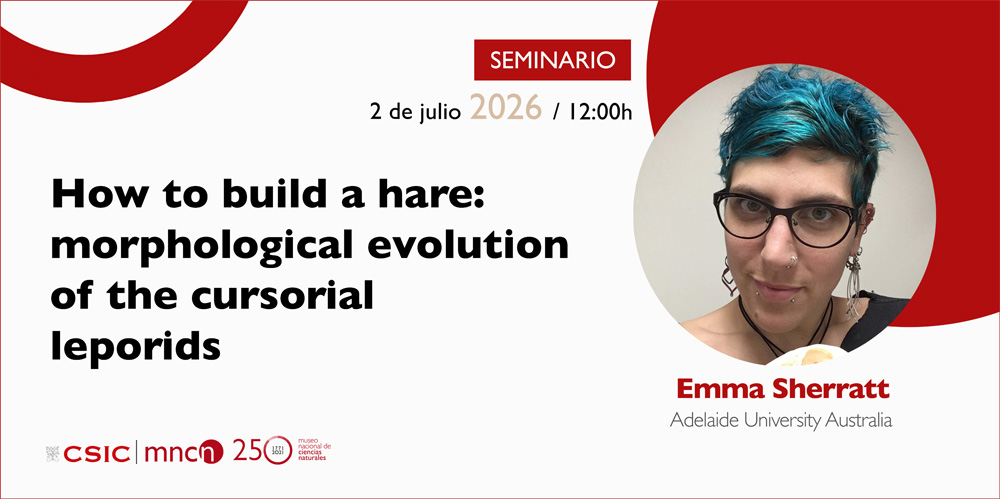
Ponente: Emma Sherratt, Associate Professor, Adelaide University Australia
Fecha y hora: viernes 2 de julio de 12:00 a 13:00
Lugar: salón de actos del MNCN
Abstract: Rabbits and hares (Leporidae) are a group of small mammals we know well, yet many stories about their evolution remain to be uncovered. This talk will focus on the cursorial leporids, hares/jackrabbits, and how their specialised skeleton has evolved. Hares are remarkable runners, and have a suite of adaptations in the skeleton, most unusually perhaps, in their skull. I shall also provide an overview of the evolution of Leporidae, highlighting some of the fascinating and likely unknown-to-the-audience species, to educate and inspire research.
Otoño 2026
CUANDO PROTEGERSE UNE: ESTRATEGIAS DE DEFENSA Y COMUNIDADES
Presencial, no se retransmite
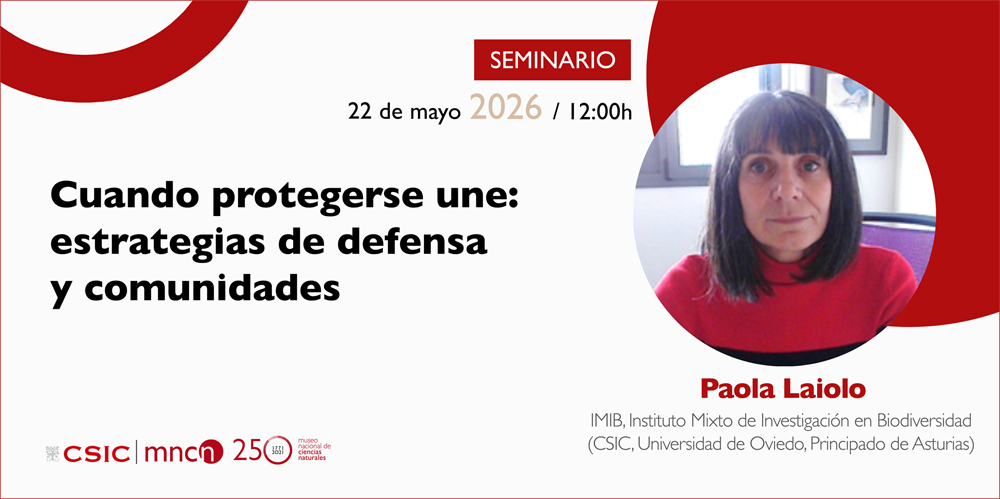
Ponente: Paola Laiolo, IMIB, Instituto Mixto de Investigación en Biodiversidad (CSIC, Universidad de Oviedo, Principado de Asturias)
Fecha y hora: aún por definir
Lugar: salón de actos del MNCN
Resumen: El seminario aborda cómo la defensa frente a depredadores puede desempeñar un papel en la estructura y diversidad de las comunidades. En aves forestales, las redes de intercambio de información acústica —donde algunas especies actúan como “informantes de la presencia de depredadores”— favorecen la coexistencia y aumentan la riqueza local más allá de factores abióticos o espaciales. De forma similar, en comunidades de abejorros, el mimetismo mülleriano promueve la coexistencia al aumentar la señal de defensa al tiempo que reduce el solapamiento de nichos y favorece una mayor diversidad de especies y recursos utilizados. En conjunto, estos mecanismos de defensa compartidos actúan como fuerzas facilitadoras en el ensamblaje de comunidades, incrementando la biodiversidad y contribuyendo a sus funciones ecológicas.
Anteriores
2026 |
2025 |
|||
2024 |
2023 |
2022 |
2021 |
2020 |
2019 |
2018 |
2017 |
2016 |
2015 |
2014 |
2013 |
2012 |
2011 |
2010 |
Galería multimedia